
Kirti Nagar Shift from Commercial Hub to Premium Residential Hub
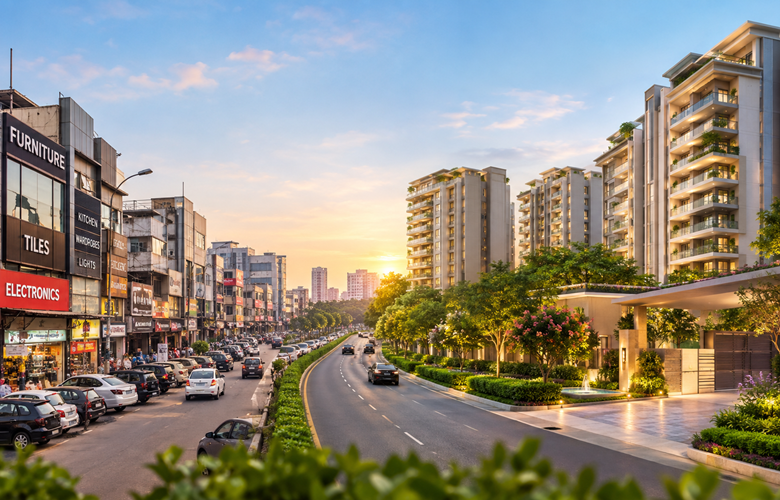
Kirti Nagar in West Delhi is evolving from a wholesale commercial identity, anchored by Asia’s largest furniture market, into a premium residential corridor. Rising apartment prices, the existing Blue and Green Line metro interchange, and organized luxury developments by TARC, DLF, and Godrej are driving the Kirti Nagar Shift from Commercial Hub toward modern residential living. TARC Kailasa Kirti Nagar Delhi further strengthens this transition along Patel Road.
The Kirti Nagar Shift from Commercial Hub is not driven by aspirational marketing. Price data, developer conviction, and infrastructure established over more than a decade make this transformation measurable. This blog examines the four structural pillars behind Kirti Nagar’s evolution and places TARC Kailasa within the wider West Delhi residential story.
KIRTI NAGAR AT A GLANCE
- Kirti Nagar apartment prices grew 62.62 percent over 5 years (Aurum Proptech / industry data cited by MagicBricks and Business Standard).
- The West Delhi luxury belt covering Moti Nagar and Kirti Nagar recorded 70 to 80 percent appreciation over 5 years, per Sam Chopra, President, eXp Realty India (Business Standard, March 2026).
- Kirti Nagar Metro Station has operated as a Blue Line and Green Line interchange since August 2011 (DMRC).
- Delhi-NCR residential prices rose 27 percent year-on-year in H1 2025 (ANAROCK Q2 2025 NCR Real Estate Report).
- Kirti Nagar hosts Asia’s largest furniture market with over 1,000 shops across the Furniture and Timber blocks (Delhi Government iconic-markets records).
- DLF One Midtown in adjacent Moti Nagar moved from around ₹18,000 per sq.ft. at launch to over ₹32,300 per sq.ft., a 79 percent gain (Business Standard, March 2026).
Why Kirti Nagar’s Identity Is No Longer Just Furniture and Timber
Kirti Nagar began as a timber trading cluster and became Asia’s largest furniture market. Over 1,000 shops operate across the Furniture and Timber blocks along Kirti Nagar Main Road, drawing designers, hoteliers and homeowners from across the country.
That identity has not disappeared. It has been repositioned. The Delhi Government’s 2022-23 budget added Kirti Nagar to a five-market redevelopment programme covering Kirti Nagar, Kamla Nagar, Khari Baoli, Lajpat Nagar and Sarojini Nagar. The plan targets underground electricity infrastructure, modern service corridors and a business-friendly ambience for the wholesale trade. Kirti Nagar Shift from Commercial Hub.
The residential story sits alongside this modernization, not against it. Buyers acquiring luxury apartments in Kirti Nagar are moving into a neighbourhood that keeps its economic engine while gaining gated residential inventory at a specification the area has never carried.
The Infrastructure That Made Premium Housing Possible in West Delhi
Kirti Nagar’s residential thesis rests on infrastructure that pre-dates the current developer interest by over a decade. Kirti Nagar Metro Station has operated on the Blue Line since 31 December 2005 and became an interchange with the Green Line on 27 August 2011 (source: Delhi Metro Rail Corporation).
This interchange puts Rajiv Chowk, Barakhamba Road, Dwarka and Noida within a single-transfer commute. Moti Nagar Metro Station sits roughly 1 km from Kirti Nagar Metro on the Blue Line, giving the micro-market two walkable access points.
Road access is equally established. Ring Road connects the corridor to South Delhi and Gurugram. Patel Road, on which TARC Kailasa Kirti Nagar Delhi is located, is an 84-meter-wide arterial. Connaught Place is situated 8 to 10 km east. In residential terms, the neighbourhood already had the transit and road spine of a Central Delhi address, without the pricing overlay.
Kirti Nagar and Adjacent Micro-Market Price Snapshot
| Micro-Market | Avg. Rate (per sq ft) | 5-Year Growth | Named Source |
| Kirti Nagar (apartments) | ₹20,630 | 62.62 percent | Aurum Proptech / MagicBricks 2025 |
| Moti Nagar (DLF One Midtown) | ₹32,300+ | 79 percent (from ₹18,000 launch) | Business Standard, March 2026 |
| West Delhi luxury belt | Composite | 70 to 80 percent | eXp Realty India | Business Standard |
| Delhi-NCR (H1 2025 YoY) | Composite | 27 percent YoY | ANAROCK Q2 2025 NCR Report |
The Five-Year Price Story | What Kirti Nagar Data Actually Shows
The clearest evidence of the residential transformation is the price series. Kirti Nagar apartments appreciated 62.62 percent over 5 years, according to Aurum Proptech data. The broader West Delhi luxury belt, covering Moti Nagar and Kirti Nagar, recorded 70 to 80 percent appreciation over the same 5-year period, per Sam Chopra, President of eXp Realty India, as reported by Business Standard in March 2026.
DLF One Midtown in adjacent Moti Nagar offers a project-level datapoint. The project launched around ₹18,000 per sq.ft. and now trades above ₹32,300 per sq.ft. 79 percent surge is cited in the same Business Standard report. The 3 BHK rental band at the project is situated at ₹1.5 to ₹2 lakh per month, 2 to 3 times higher than legacy West Delhi rentals.
For context, ANAROCK’s Q2 2025 NCR Real Estate Report placed Delhi-NCR residential price appreciation at 27 percent year-on-year in H1 2025. Kirti Nagar and Moti Nagar have therefore outpaced the wider NCR mean over both 1-year and 5-year windows. The pattern is consistent, not episodic.
Developer Conviction | How TARC, DLF and Godrej Are Reading the Micro-Market
Institutional developer entries are the second signal. Three listed or well-capitalized developers now have residential inventory concentrated in the Kirti Nagar and Moti Nagar corridor.
- TARC has launched TARC Kailasa Kirti Nagar Delhi on Patel Road in January 2023, a 6.2-acre gated development with 5 towers and 417 units.
- DLF has built out DLF Capital Greens and DLF One Midtown in adjacent Moti Nagar, seeding the corridor for a decade before the current price cycle.
- Godrej Properties is active across Delhi with Godrej South Estate and Godrej Connaught One, reinforcing developer interest in Delhi luxury residential rather than only NCR peripheries.
This concentration is not accidental. Listed developers underwrite land at multiples of prevailing rates only when they read a durable pricing floor. Three of them making that read on the same corridor is a structural signal, not a coincidence.
The West Delhi Value Proposition That Gurugram Cannot Replicate
The most common question West Delhi luxury buyers face is why not Gurugram. The framing is misleading. Kirti Nagar and Gurugram are not the same product.
Kirti Nagar sits inside Delhi’s municipal limits. Connaught Place is 8 to 10 km away. Ring Road offers direct road access. The Blue and Green Line interchange links the micro-market to Central, South, East and North Delhi through a single transfer. For a buyer who has used West Delhi schools, hospitals, and family networks for two decades, relocating 40 km south is a life change, not a housing choice.
What changed is the specification. Historically, a West Delhi buyer had to accept builder floors in Rajouri Garden, Punjabi Bagh or Karol Bagh, or leave the district for gated luxury. The current wave of premium residential projects in Kirti Nagar and Moti Nagar closes that gap. TARC Kailasa Kirti Nagar , DLF One Midtown, and DLF Capital Greens deliver the amenity depth, clubhouse scale, and construction standards once available only in Gurugram or South Delhi.
Where TARC Kailasa Kirti Nagar Delhi Fits in the Residential Story
TARC Kailasa Delhi occupies 6.2 acres on Patel Road, with 5 high-rise towers rising to G+33 floors and delivering 417 residences. Configurations are limited to 3.5 and 4.5 BHK, with unit sizes from 3,440 to 4,246 sq ft. Sixty percent of the plot is planned as open green area. The clubhouse spreads across 1.75 lakh sq.ft.
In micro-market terms, the project sets a specification benchmark that Kirti Nagar has not previously carried. It launched in January 2023, positioning it early in the current price cycle. Blue Line and Green Line interchange access at Kirti Nagar Metro is situated within walking distance from the site.
“The Kirti Nagar buyer is not proving the location. The location is proving the buyer’s twenty-year residency thesis.”
5 Reasons the Kirti Nagar Transformation Is Structural, Not Cyclical
- Metro interchange and Ring Road connectivity were operational before the current price cycle began, so the residential thesis rides existing infrastructure rather than promised infrastructure.
- Five-year price appreciation of 62.62 percent in Kirti Nagar and 70 to 80 percent across the West Delhi luxury belt outpaces the Delhi-NCR mean of 27 percent year-on-year in H1 2025.
- Three institutional developers, TARC, DLF and Godrej, hold residential inventory in the corridor, signalling underwritten land value at multiple decision points.
- The Delhi Government’s 2022-23 budget commitment to redevelop Kirti Nagar as one of 5 iconic markets protects the commercial engine that historically supported the neighbourhood economy.
- A luxury inventory of Gurugram-grade specifications is now available inside Delhi’s municipal limits, removing the relocation trade-off for West Delhi-anchored buyers.
What We Are Seeing on the Ground in Kirti Nagar
The buyer profile at TARC Kailasa is specific. We are meeting West Delhi families who have owned builder floors in Rajouri Garden, Punjabi Bagh, Karol Bagh, or witnessed the Kirti Nagar Shift from Commercial Hub and are now looking for organized, gated luxury without leaving their social and educational anchor. This is not the Gurugram-versus-Delhi debate the media frames. It is quieter. A family that already sends children to schools on Ring Road, whose extended family lives ten minutes away, and whose family business runs from Patel Nagar, does not want to relocate 40 km south. They want the specification a Sector 63A Golf Course Extension buyer would expect, delivered inside their own postal code.
A recent walk-in was a senior partner at a professional services firm whose commute to Barakhamba Road never takes more than 30 minutes on the Blue Line. Their objection had nothing to do with the neighbourhood. It was about floor-plate efficiency in a 4.5 BHK layout. That is the level of question we are now fielding. Buyers are not asking whether Kirti Nagar has arrived. They are asking whether the specific unit and floor deliver on the promise their twenty-year West Delhi residency has already made.
Key Takeaways
Kirti Nagar has crossed the point where its transformation can be dismissed as a marketing narrative. Data, developer entries and pre-existing infrastructure are aligned.
- The furniture and timber trade continues to operate, but no longer defines the neighbourhood’s residential ceiling.
- Five-year apartment price growth of 62.62 percent in Kirti Nagar and 70 to 80 percent across the West Delhi luxury belt give the transformation a numerical foundation.
- Metro interchange, Ring Road access and 8 to 10 km proximity to Connaught Place were structural advantages waiting for organized inventory.
- TARC Kailasa Delhi, DLF Capital Greens and DLF One Midtown mark the first wave of gated luxury built to global specification inside Delhi’s municipal limits.
- Buyers with an established West Delhi anchor now have an alternative to relocation south or east.
For a closer look at 3.5 and 4.5 BHK residences on Patel Road, explore the floor plans at TARC Kailasa Delhi.
Read more: https://www.tarckailasadelhi.com/blog/
FAQ
Is Kirti Nagar Delhi becoming a residential area?
Kirti Nagar is transitioning from a wholesale commercial identity into a mixed residential and lifestyle destination. Organized luxury launches by TARC, DLF, and Godrej, combined with 62.62 percent five-year apartment price growth per Aurum PropTech data and the Delhi Government’s iconic-markets redevelopment program, mark a structural shift rather than a short-term price cycle.
What is the current property price per sq.ft. in Kirti Nagar, Delhi?
Kirti Nagar apartment prices average around ₹19,800 to ₹20,630 per sq.ft. with a range of roughly ₹15,059 to ₹26,216 per sq.ft. depending on project positioning, per 99acres and Aurum Proptech data. Premium new-launch inventory in adjacent Moti Nagar, such as DLF One Midtown, has crossed ₹32,300 per sq.ft.
When did Kirti Nagar start shifting toward premium residential development?
The transition accelerated between 2020 and 2025. DLF launched One Midtown in Moti Nagar during 2021, TARC introduced TARC Kailasa Kirti Nagar Delhi in January 2023 on Patel Road, and the Delhi Government’s 2022-23 budget added Kirti Nagar to its 5-market redevelopment programme. Metro interchange access had already been in place for over a decade.
How does Kirti Nagar compare with Gurugram for luxury home buyers?
Kirti Nagar sits inside Delhi’s municipal limits, 8 to 10 km from Connaught Place, with an existing Blue and Green Line metro interchange. Gurugram offers newer master-planned corridors but requires longer commutes to central Delhi. For buyers already anchored to West Delhi’s schools, hospitals and business networks, Kirti Nagar removes the relocation friction Gurugram introduces.
Is Kirti Nagar still a furniture market?
Yes. The Furniture and Timber blocks remain operational as Asia’s largest furniture market with over 1,000 shops. The Delhi Government announced a redevelopment plan in the 2022-23 budget covering Kirti Nagar, Kamla Nagar, Khari Baoli, Lajpat Nagar and Sarojini Nagar. The commercial identity is being modernized, not removed, and coexists with the new residential corridor.
What connectivity does Kirti Nagar offer for professionals working in Central Delhi?
Kirti Nagar Metro Station is an interchange between the Blue Line and Green Line, with direct connections to Rajiv Chowk, Barakhamba Road, Dwarka and Noida. Ring Road provides road access to South Delhi and Gurugram. Moti Nagar Metro Station is situated roughly 1 km from Kirti Nagar Metro, giving the area two walkable metro access points.
Which developers have entered the Kirti Nagar and Moti Nagar residential market?
TARC has launched TARC Kailasa Kirti Nagar Delhi on Patel Road. DLF developed DLF Capital Greens and DLF One Midtown in adjoining Moti Nagar. Godrej Properties is active across Delhi through Godrej South Estate and Godrej Connaught One. This concentration of listed developers signals institutional conviction rather than isolated project bets on the corridor.
How much has Kirti Nagar property appreciated over the last 5 years?
Kirti Nagar apartment prices grew 62.62 percent over 5 years, per Aurum Proptech data. The wider West Delhi luxury belt, which includes Moti Nagar, recorded 70 to 80 percent appreciation over the same 5-year window, according to Sam Chopra, President of eXp Realty India, as reported by Business Standard in March 2026.
What is TARC Kailasa Kirti Nagar Delhi?
TARC Kailasa Kirti Nagar Delhi is an ultra-luxury residential development on Patel Road, spread across 6.2 acres with 5 high-rise towers rising to G+33 floors. The project offers 417 residences in 3.5 and 4.5 BHK configurations, ranging from 3,440 to 4,246 sq.ft. with 60 percent open green area and a 1.75 lakh sq.ft. clubhouse.
What amenities do premium projects in Kirti Nagar typically offer?
Premium Kirti Nagar projects centre on large clubhouses, temperature-controlled swimming pools, dedicated fitness zones, private lift lobbies, and landscaped green cover exceeding 50 percent of the plot. Concierge desks, multi-tier security, and hospitality-grade material palettes are becoming standard. TARC Kailasa Kirti Nagar Delhi’s 1.75 lakh sq.ft. clubhouse sets one benchmark for the corridor.